
2026年11月24日
Concentrated Solar Power vs. Photovoltaic (PV): Which Solar Technology Makes Sense in 2026?
Solar energy comes in two fundamentally different flavors. Photovoltaic (PV) panels convert sunlight directly into electricity. Concentrated solar power (CSP) plants use mirrors to focus sunlight, heat a fluid, and drive a turbine — the same thermodynamic cycle behind coal and nuclear plants, just fueled by the sun.
On paper, PV looks like the obvious winner: it is cheaper, simpler, and has scaled roughly 300 times faster than CSP. But CSP keeps winning a game PV struggles with — storing energy cheaply and dispatching power on demand, even after sunset.
This guide compares CSP vs. PV across efficiency, cost, storage, grid value, and site requirements, using the latest 2026 data, so you can decide which technology fits your project.
How Each Technology Works
Photovoltaic: direct conversion
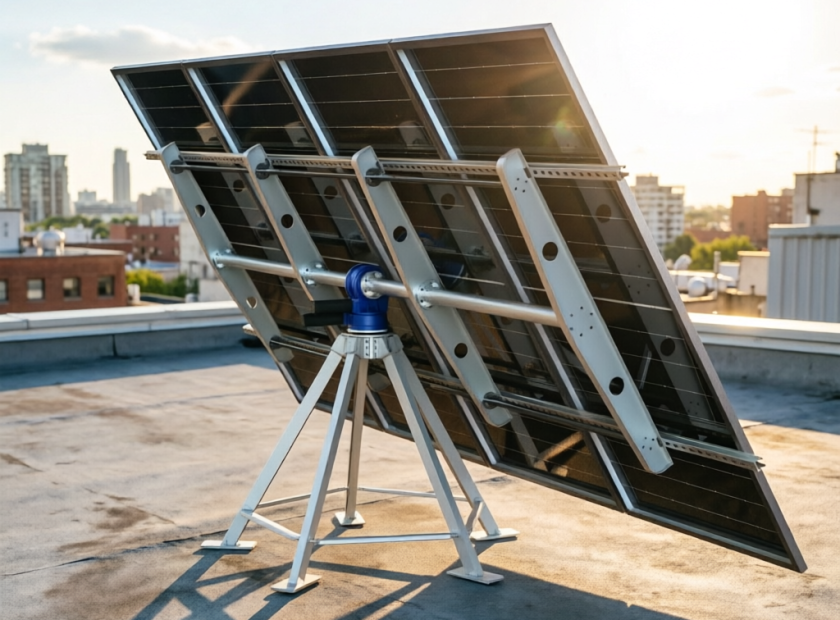
PV cells, almost always crystalline silicon, exploit the photovoltaic effect: photons knock electrons loose in a semiconductor, producing DC current that an inverter converts to AC. There are no moving parts in the generation step, and PV works in diffuse light — meaning panels produce power on cloudy days, albeit at reduced output.
Concentrated solar power: heat first, then generate
CSP systems concentratedirect normal irradiance (DNI)with mirrors onto a receiver. The dominant plant designs are:
- Parabolic troughs— curved mirrors focus light on a pipe along the focal line (~60% of installed CSP)
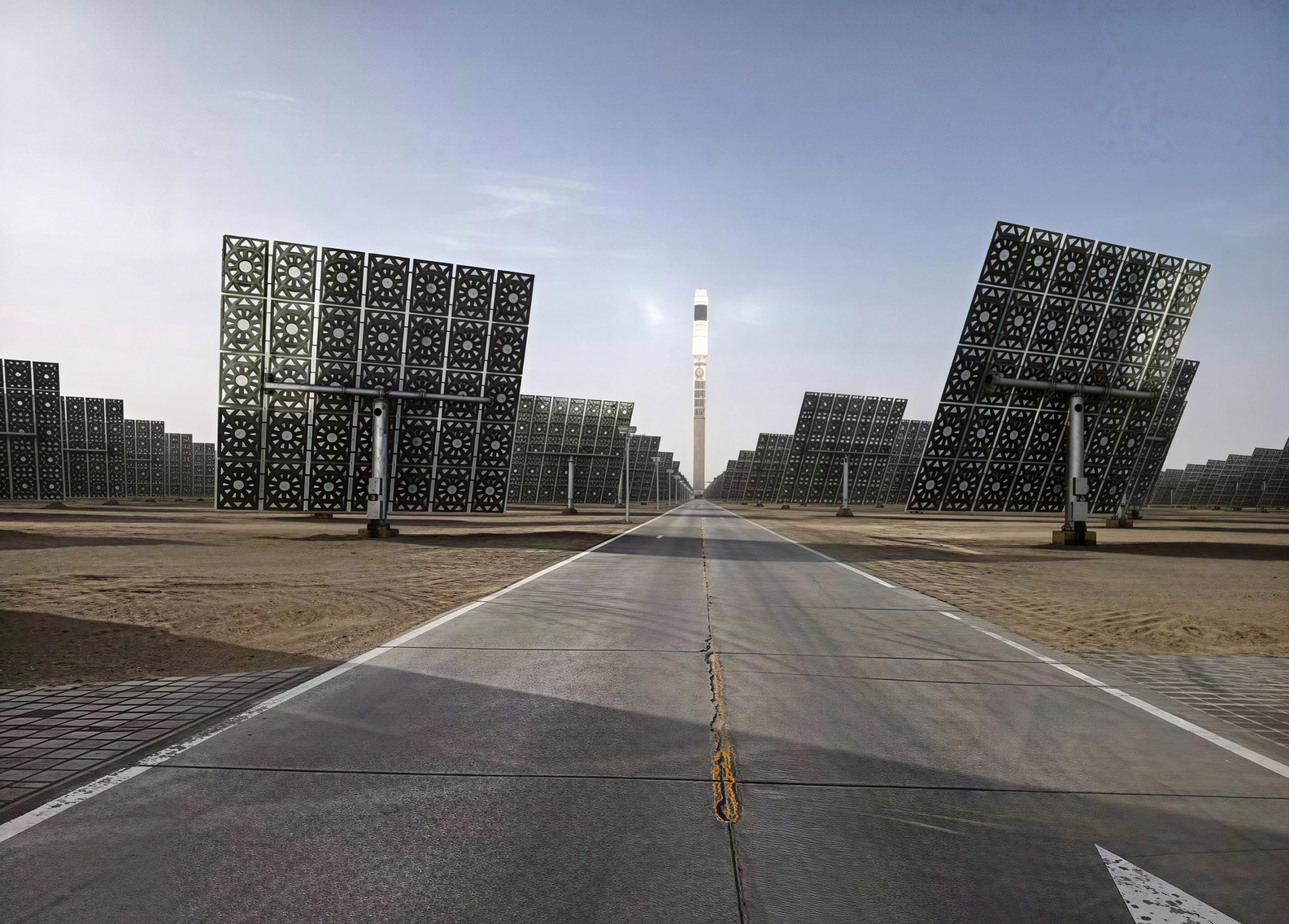
- Power towers— heliostats aim at a central receiver, reaching higher temperatures (565 °C+ with molten salt)
- Linear Fresnel reflectors— cheaper, flatter mirror rows with lower efficiency
- Dish Stirling— high per-unit efficiency, but niche and not widely commercialized
Crucially, CSP only works where the sun shines directly. Diffuse cloud light cannot be concentrated, which is CSP’s biggest geographic constraint.
Efficiency: CSP vs. PV
“Efficiency” means different things for these two technologies, and comparing a single number is misleading.
| Metric | Solar PV | CSP |
| Panel/receiver-to-grid conversion | ~21–23% module efficiency (mainstream N-type modules; cells exceed 26%) | ~15–20% solar-to-electric for troughs; towers slightly higher |
| Performance in cloudy/diffuse light | Still produces power | Essentially stops — needs direct sun |
| Temperature sensitivity | Output drops as cells heat up (~0.3–0.4%/°C) | Higher temperatures can improve cycle efficiency |
| Annual capacity factor | 15–30% depending on location | 30–50%+ when paired with thermal storage |
| Degradation | ~0.4–0.5% per year | Turbine O&M–driven, generally stable efficiency; mirrors need regular cleaning |
PV converts more of the sunlight hitting it into electricity, and it keeps producing under weak light. CSP’s advantage is the thermal cycle: storage and high capacity factors raise theusefulnessof each installed megawatt, even when per-square-meter conversion efficiency is lower.
Bottom line:PV wins on conversion efficiency and diffuse-light performance; CSP wins on how much of its capacity can be dispatched when the grid wants it.
Cost: LCOE and Upfront Capex
This is where the comparison is most lopsided — and where storage changes the picture.
Without storage: PV wins decisively
- IRENA’sRenewable Power Generation Costs in 2025(published July 2026) puts the global weighted-average utility-scalePV LCOE at USD 44/MWh, roughly flat versus 2024. Between 2010 and 2025, PV costs fell about 89%.
- Lazard’s 2026 LCOE analysis gives unsubsidized utility-scale PV a range of roughly$40–98/MWh— the lowest band of any generation technology, though slightly up from 2025 on tariffs, financing costs, and trade barriers.
- CSP, by contrast, typically lands in the$80–140+/MWhrange, having fallen about 72% since 2010 (IRENA) but from a much higher base.
- Capital costs reflect the gap: utility-scale PV plants are built for roughly$700–1,200/kW, while CSP plants cost about$3,000–11,000/kW(Khan et al.,Renewable and Sustainable Energy Reviews, 2024) — they are, in effect, a mirror field plus a small conventional power plant.
No wonder PV has drawn nearly all new solar investment worldwide. Global PV installed capacity is measured in terawatts; total CSP remains only a handful of gigawatts.
With long-duration storage: CSP becomes competitive
The comparison flips when you ask each technology to deliver power after dark.
- CSP stores heat inmolten salt tanksas an integral part of the plant — typically 6–15 hours of storage, with incremental storage costing on the order of $15–50/kWh-thermal, far below batteries.
- A peer-reviewed comparison found that at storage durations above roughly 400+ MWh of daily shifting, CSP’s all-in LCOE can beat PV plus batteries, landing around$130/MWhwhile PV+battery configurations climb steeply with duration.
- IRENA’s 202624/7 Renewablesreport estimates firm (round-the-clock) solar-plus-storage at$54–82/MWhin the best resource regions with batteries — meaning PV+BESS still wins for short-duration (2–6 hour) shifting, while CSP’s economics hold up better for very long, multi-day firming in high-DNI regions.
Bottom line:For energy-only projects without firming obligations, PV is the cheapest electricity on earth. Where a buyer needs guaranteed evening or overnight delivery at long durations, CSP-with-storage becomes genuinely competitive — or cheaper than deep battery arrays.
Dispatchability and Grid Services
This is CSP’s strongest card, and it is about more than storage volume.
CSP is dispatchable by design.Thermal storage plus a steam turbine lets a CSP plant follow load like a gas plant: ramp up at the evening peak, hold output for hours, even run through the night. Some towers can also hybridize with natural gas or biomass as a back-up fuel.
CSP provides physical grid stability.Because CSP drives a synchronous generator, it naturally supplies:
- Rotational inertia— real resistance to frequency excursions
- Reactive power and voltage support— without dedicated devices
- Fault-current contribution— helpful in weak grids
PV through inverters can synthesize some of these services (grid-forming inverters are advancing quickly), but inertia and short-circuit strength remain an engineering cost added to PV-dominated grids. In weak or isolated grids — island nations, mining microgrids, North African and Middle Eastern interconnections — CSP behaves like a conventional plant, and that reduces system-level costs elsewhere.
PV, meanwhile, is famously fast to deploy: a 100 MW solar farm energizes in months, while a comparable CSP plant with towers and salt tanks takes three to four years to build.
Land, Water, and Site Requirements
| Factor | Solar PV | CSP |
| Best geography | Any sunny region, including temperate/mild climates | High-DNI deserts only (SW USA, MENA, Chile, China’s northwest, Australia, South Africa) |
| Land use per MWh | Higher land needed per annual MWh without storage; can be dual-use (agrivoltaics, rooftop) | Lower land per dispatched MWh when storage is included; large contiguous parcels required |
| Water use | Essentially none during operation | Wet-cooled towers need cooling water (1–2 m³/MWh-class); modern plants use air cooling at an efficiency penalty |
| Modular scalability | Watts to gigawatts, rooftop to utility | Economically viable mainly at 50 MW+ |
| Complexity & skills | Low; panels + inverters | High; requires power-plant O&M crews |
PV can go almost anywhere. CSP demands a very specific resource — strong, consistent direct sunlight — plus a large site, and in many cases water or expensive air-cooling. This is the main reason CSP deployment has stalled outside a handful of sun-belt countries.
Which Should You Choose? A Decision Framework
Choose PV when:
- You want the lowest-cost energy per kWh with no firming requirement
- Sites are small, distributed, rooftop, or outside premium DNI zones
- Speed of build matters (months, not years)
- You can pair cheap batteries for 2–6 hour evening shifting
Choose CSP when:
- You need dispatchable, multi-hour or overnight solar in a high-DNI region
- Your grid is weak and values inertia, voltage support, and synchronous generation
- A capacity-payment or firming contract (replacing a coal/gas plant) rewards availability over raw energy price
- Long-duration firming makes PV + deep battery storage cost-prohibitive
Consider a hybrid CSP–PV plant when: recent techno-economic studies (e.g., Morocco’s Noor Midelt project, Saudi NEOM) show that co-locating PV with an existing CSP storage-and-turbine train raises capacity factor and lowers combined LCOE — the PV feeds cheap midday energy into shared thermal and grid infrastructure.
The Market Reality in 2026
PV dominates new capacity: utilities and developers overwhelmingly select it for energy-only procurement, and manufacturing overcapacity has kept module prices near historic lows despite tariff walls in the US and EU. CSP, meanwhile, has been repositioned — not as a cheap-energy technology, but as a firming and grid-support asset. New pipelines concentrate in China’s deserts (multiple 100–200 MW towers with 12–14 h storage), the Middle East and North Africa, and Chile, often explicitly designed to displace coal or gas peakers rather than to compete with bare PV.
The honest summary: PV and CSP are not substitutes in the same auction. They solve different problems — energy vs. reliability — and increasingly complement each other in the same portfolio.
FAQ
Is CSP more efficient than PV?
No — at the panel level, PV converts more sunlight to electricity (~21–23% vs. ~15–20% for CSP plants). CSP only “wins” on useful energy delivered because thermal storage lets it generate when the sun is down.
Why is CSP more expensive than solar panels?
CSP is a full thermal power station — mirror field, receiver, heat-transfer fluid, storage tanks, turbine, condenser — costing several times more per kW than PV, which is modules and inverters. Scale and competition have kept PV cheap; CSP’s small market has not.
Can PV replace CSP with batteries?
For short shifting (2–6 h), almost always yes — PV plus lithium batteries undercuts CSP in most markets today. For long-duration firming in remote high-DNI areas, molten-salt CSP can still be cheaper and adds grid inertia that batteries do not.
Does CSP work on cloudy days?
Not meaningfully. CSP concentrates direct sunlight only; diffuse light cannot be focused. PV keeps producing (at reduced output) under clouds.
What is the future of CSP?
CSP’s growth path runs through firm solar, coal-replacement, hybrid CSP–PV, and industrial process heat. Efficiency gains from supercritical CO₂ cycles and higher-temperature particles could narrow the cost gap, but PV will remain the default choice for pure energy generation.
Sources for key figures: IRENA, Renewable Power Generation Costs in 2025 (July 2026); IRENA, 24/7 Renewables: The Economics of Firm Solar and Wind (May 2026); Lazard LCOE 2026; Khan et al., “The economics of concentrating solar power,” Renewable and Sustainable Energy Reviews 200 (2024); US DOE/NREL utility-scale solar benchmarks.
Word count: ~1,500. Recommended internal links: solar LCOE explainer, molten salt storage deep-dive, hybrid plant case studies. Suggested hero image alt text: “aerial view of a molten-salt concentrated solar power tower plant next to a utility-scale photovoltaic array”.