
How to Size a Solar Energy System for Your Home (2026 Calculator Guide)
Introduction
Picking the wrong size for your solar energy system is one of the most expensive mistakes a homeowner can make. Go too small, and you will still be paying the utility company every month. Go too big, and you will spend thousands on panels and inverters you never actually use.
Yet most homeowners never learn how to calculate the right size. They rely on a salesperson’s estimate, a generic online calculator, or a neighbor’s setup that may not match their home at all.
This guide walks you through the exact process a qualified solar installer uses to size a solar energy system — from reading your electricity bill to calculating the number of panels, inverter capacity, and optional battery storage. By the end, you will be able to check any quote you receive against your own math.
Step 1: Find Your Annual Electricity Usage
The first number you need is your annual electricity consumption, measured in kilowatt-hours (kWh). This is the single most important input for sizing a solar energy system.
How to get the number
- Log into your utility provider’s online portal and look for “annual usage summary” or “12-month kWh history.”
- Add up the last 12 months of consumption.
- If you cannot access 12 months of data, take your most recent bill’s kWh, multiply by 12, and add a 10% buffer for seasonal variation.
Typical household consumption in the United States
Home Size | Annual Usage (kWh) | Monthly Average |
Small apartment or condo | 4,000 – 6,000 | 330 – 500 |
Average single-family home | 8,000 – 12,000 | 670 – 1,000 |
Large home with pool, EV, or electric heat | 14,000 – 22,000 | 1,170 – 1,830 |
If your home falls outside these ranges, your actual bill is the number that matters — not the average.
Step 2: Adjust for Future Changes
A solar energy system lasts 25 to 30 years. Your electricity usage in year one is unlikely to match your usage in year ten. Before finalizing your system size, consider any upcoming changes:
- Electric vehicle (EV). Adding an EV typically increases annual usage by 3,000 to 5,000 kWh.
- Heat pump or electric water heater. Switching from gas to electric heat can add 2,000 to 4,000 kWh per year.
- Pool pump or hot tub. Adds 1,500 to 3,000 kWh annually.
- Home addition or finished basement. Extra square footage means more lighting, HVAC, and appliance load.
If any of these apply within the next five years, increase your annual usage target by that amount before sizing the system. Oversizing slightly now is almost always cheaper than adding panels later.
Step 3: Calculate the System Size in Kilowatts
Once you have your adjusted annual kWh, you can calculate the size of the solar energy system you need. The formula is:
System size (kW) = Annual kWh usage ÷ (peak sun hours per day × 365 × system efficiency factor)
Understanding the variables
- Peak sun hours per day. This is not the same as daylight hours. It represents the equivalent hours per day when the sun is strong enough to produce the panel’s rated output. In the U.S., this ranges from roughly 3.5 hours (northern states) to 5.5 hours (southwest).
- System efficiency factor. Real-world losses from wiring, inverter conversion, temperature, dust, and shading typically reduce production by 20% to 25%. Use 0.80 as a conservative figure.
Example calculation
A home in Texas (5.0 peak sun hours) with an adjusted annual usage of 10,000 kWh:
System size = 10,000 ÷ (5.0 × 365 × 0.80) = 10,000 ÷ 1,460 ≈ 6.85 kW
Rounding up to 7 kW gives a small buffer for cloudy years and panel degradation.
Reference table by region
Region | Peak Sun Hours | System Size for 10,000 kWh/year |
Northeast (e.g., Boston) | 3.8 | 9.0 kW |
Midwest (e.g., Chicago) | 4.2 | 8.2 kW |
Southeast (e.g., Atlanta) | 4.6 | 7.5 kW |
Southwest (e.g., Phoenix) | 5.5 | 6.3 kW |
Pacific Northwest (e.g., Seattle) | 3.5 | 9.8 kW |
Step 4: Determine the Number of Panels
Panel wattage has increased steadily over the past decade. Most residential panels installed today are rated between 400 and 450 watts.
Number of panels = System size (W) ÷ panel wattage
Using the 7 kW Texas example with 420-watt panels:
Number of panels = 7,000 ÷ 420 ≈ 17 panels
Roof space consideration
Each standard residential panel measures approximately 65 inches by 39 inches (about 17.5 square feet). Seventeen panels require roughly 300 square feet of unobstructed roof area — a significant but manageable footprint on most single-family homes.
If your available roof area is smaller than what your calculated system needs, you have three options:
- Use higher-wattage commercial-grade panels.
- Accept partial offset (e.g., 80% of usage instead of 100%).
- Consider a ground-mounted array if yard space allows.
Step 5: Size the Inverter
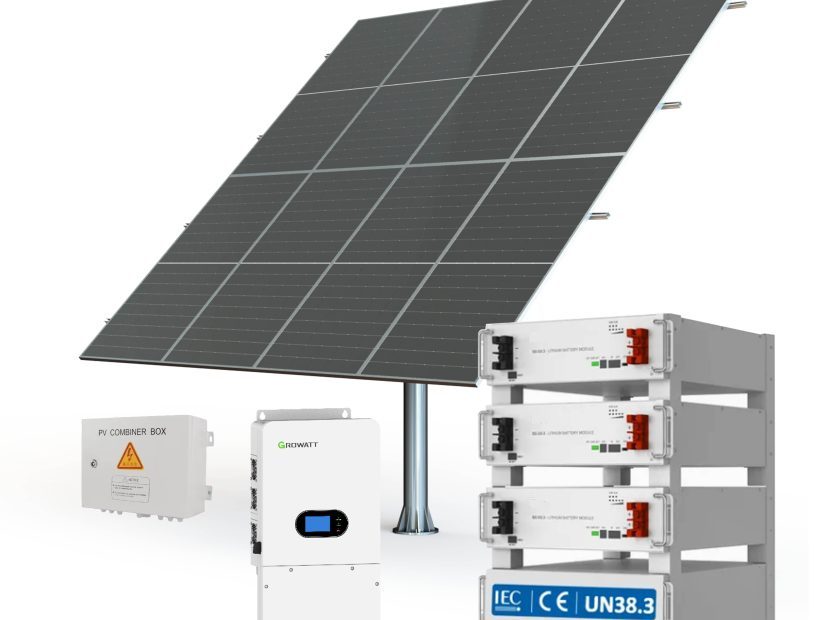
The inverter is the second most critical component of any solar energy system. Its job is to convert the DC electricity produced by your panels into the AC electricity your home uses.
Inverter sizing rule of thumb
Most installers size the inverter at 80% to 100% of the total DC panel capacity. This ratio, called the DC-to-AC ratio or inverter loading ratio (ILR), balances production clipping against cost.
- ILR of 1.0 — Inverter matches panel capacity exactly. No clipping, but you pay for a larger inverter.
- ILR of 1.15 to 1.25 — Slight clipping on the brightest days, but lower cost and better performance during morning, evening, and cloudy conditions.
- ILR above 1.3 — Significant clipping losses, rarely recommended.
For the 7 kW system above, a 6 kW to 7 kW inverter would be the appropriate range.
Inverter types
- String inverter. One central unit for the entire array. Lowest cost, but shading on a single panel can reduce output across the whole string.
- One small inverter attached to each panel. Higher cost, better performance on shaded or complex roofs.
- Power optimizers + string inverter. A middle ground — optimizers on each panel condition the DC output before sending it to a central inverter.
The right choice depends on roof complexity, shading, and budget.
Step 6: Decide Whether You Need Battery Storage
A solar energy system with battery storage adds resilience but also significant cost. Before adding a battery, ask yourself these three questions:
Does your utility offer net metering?
If yes, you effectively use the grid as a free, unlimited battery — exporting surplus during the day and drawing it back at night. In this case, a battery rarely makes financial sense on its own.
Are grid outages common where you live?
If you experience outages more than a few times per year, a battery provides genuine value as a backup power source, independent of solar economics.
Does your utility have time-of-use rates with a high evening peak?
In regions like California, where electricity prices spike between 4 p.m. and 9 p.m., a battery can store cheap midday solar energy and discharge it during expensive evening hours — saving meaningful money each month.
Battery sizing basics
If you decide to add a battery, a typical starting point is 10 to 15 kWh of usable capacity — enough to power essential circuits (lights, refrigerator, Wi-Fi, one HVAC zone) through a single night.
Popular residential batteries and their usable capacity:
Battery | Usable Capacity |
Tesla Powerwall 3 | 13.5 kWh |
Enphase IQ 5P | 5 kWh (stackable) |
Franklin WH aPower 2 | 13.6 kWh |
Generac PWRcell | 9 – 18 kWh (modular) |
Step 7: Verify the Quote Against Your Math
When you receive a proposal from a solar installer, compare their numbers to your own calculations:
- System size (kW). Does it match or come within 10% of your Step 3 figure?
- Panel count. Multiply the number of panels by the panel wattage. It should equal the quoted system size.
- Projected annual production (kWh). This should roughly match your adjusted annual usage from Step 2.
- Inverter capacity. Check that the DC-to-AC ratio falls between 1.0 and 1.25.
- Panel performance warranty should guarantee at least 80% output at year 25.
If a quote deviates significantly from your numbers in any of these areas, ask the installer to explain why before signing.
Common Sizing Mistakes to Avoid
- Using last month’s bill instead of a full year. Summer air conditioning or winter heating can skew a single month far from the annual average.
- Ignoring future electrification. If you plan to buy an EV or install a heat pump, your system will be undersized within a few years.
- Assuming more panels always equals better. Oversizing beyond your inverter’s capacity leads to clipping losses; oversizing beyond your usage means paying for energy you cannot use or export.
- Forgetting roof condition. Installing a new solar energy system on a roof that needs replacement in 3 to 5 years means paying for removal and reinstallation on top of the new roof cost.
- Relying on a single quote. Prices per watt vary widely by installer. Three quotes is the practical minimum.
Frequently Asked Questions
Can I size my solar energy system without my electricity bill?
You can estimate using your home’s square footage and local averages, but the result will be significantly less accurate. Your actual bill is always the best starting point.
What if my roof cannot fit enough panels for my full usage?
Aim for 70% to 80% offset instead of 100%. Most utilities allow you to draw the remainder from the grid, and net metering still credits the solar portion you produce.
Does panel orientation affect system size?
Yes. South-facing panels produce the most energy in the Northern Hemisphere. East- or west-facing panels produce roughly 15% to 20% less, which means you would need more panels to reach the same annual output.
Will my solar energy system still produce enough in winter?
Production drops in winter due to shorter days and lower sun angle, but the system is sized on annual totals — summer surplus offsets winter shortfalls. Battery storage or net metering bridges the seasonal gap.
How accurate are online solar calculators?
Most online calculators provide a reasonable ballpark within 15% to 20%. For a precise number, the manual calculation in this guide — using your actual bill and local peak sun hours — will be significantly more accurate.
Conclusion
Sizing a solar energy system is not a mystery reserved for engineers or installers. With your electricity bill, a few regional constants, and the formulas in this guide, you can calculate the right system size in under an hour.
The payoff is significant: you will receive quotes with confidence, spot inaccurate proposals immediately, and avoid the two most common homeowner mistakes — overspending on a system that is too large or regretting one that is too small.
Start with your last 12 months of usage, run the numbers, and bring your own estimate to every installer conversation. That single habit will save you more money than any sales pitch ever could.