



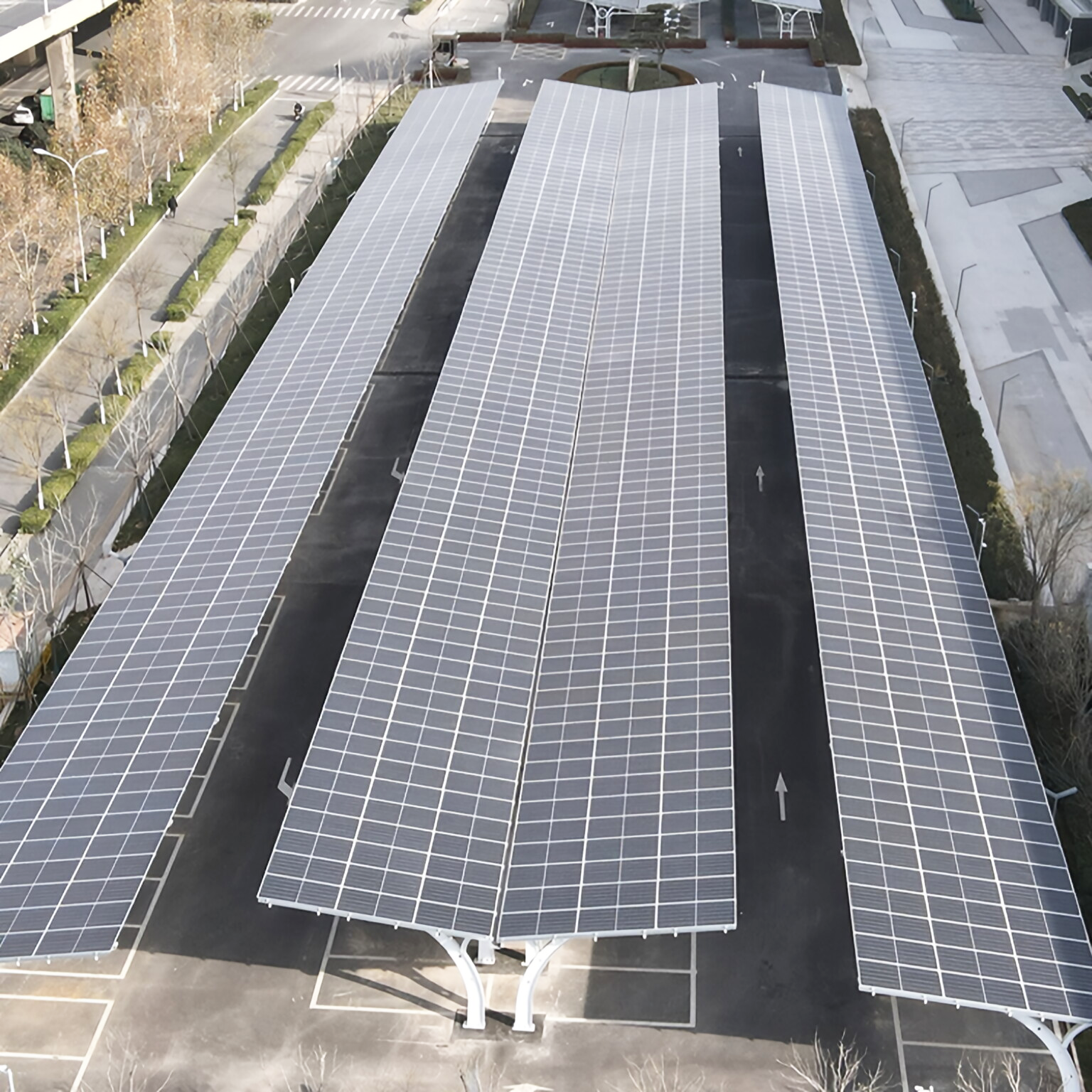
Solar Carport Frame Material: Aluminum vs. Carbon Steel — Which One Should You Build With?
A solar carport has to do two jobs at once: carry 25+ years of weather and hold a photovoltaic canopy safely over parked cars and people. Panels degrade slowly and predictably; the frame either keeps standing rust-free or it doesn’t. That makes the frame material — extruded aluminum alloy or carbon steel with a hot-dip galvanized (HDG) coating — the most consequential hardware decision in a carport project, even though it’s the component most buyers see last.
This guide compares both materials on the five criteria that actually decide the outcome: corrosion life, strength and deflection, weight and installability, cost, and maintenance.
What Each Material Actually Is
Carbon steel frame. Structural carports use common grades such as Q235 or Q355 (yield strengths of 235 and 355 MPa), formed into C/Z purlins, square tubes, or welded cells, then hot-dip galvanized after fabrication. The zinc coating is the entire corrosion strategy: international standard ISO 1461 specifies a minimum of roughly 65–85 µm of zinc depending on steel thickness, and typical PV-mounting production runs zinc layers of 55–80 µm.
Aluminum frame. Solar racking almost always uses heat-treatable extruded alloys — 6005-T5 or 6063-T5 for standard structures, 6061-T6 for higher loads. Corrosion protection comes from anodizing (a controlled oxide film, typically 10–25 µm) or, in some product lines, powder coating. The material protects itself; there is no sacrificial layer to run out.
Corrosion Resistance: The Deciding Battle
In an inland, dry industrial site, both systems reach end-of-life for reasons other than rust. In aggressive environments, they diverge sharply.
- Steel depends on coating integrity. Hot-dip galvanizing is excellent while intact: a well-applied 85 µm coating can deliver 60–100 years of protection in benign rural atmospheres and reliably holds 20+ years at typical industrial sites. But a carport frame is drilled, cut, welded, and bolted on site, and every damaged spot must be touched up immediately — once the zinc is breached at a scratch or a cut thread, the exposed steel rusts from within and the corrosion creeps under the coating. For severe coastal (C5) atmospheres, keeping an HDG steel mount alive for 25 years would require a much heavier 140 µm coating, which increases brittleness, cost, and production difficulty.
- Aluminum doesn’t rust; it repasses. Alloy surfaces form a self-healing oxide film. In an accelerated salt-spray test, 5052-series aluminum held off visible corrosion for 240 hours, while bare Q235 carbon steel showed red rust at 48 hours. Anodized 6005-T5 racking is considered essentially maintenance-free for the life of the array in most environments, with the exception of heavily polluted or marine sites.
Rule of thumb: beyond roughly a few kilometers from the coast and away from chemical or fertilizer plants, HDG steel and aluminum are functionally equivalent on corrosion. Inside that zone — coastal carports, industrial emission areas — aluminum (or a zinc-aluminum-magnesium coated steel upgrade) becomes the defensible choice.
Strength and Deflection: Steel’s Home Court
Carbon steel wins on raw load capacity. Tensile strength for galvanized structural steel runs roughly 250–550 MPa versus about 270 MPa for 6005-T5 aluminum. More important for a canopy is stiffness: steel’s elastic modulus is about three times aluminum’s, and industry references put aluminum profile deflection at approximately 2.9 times that of an equivalent steel member under the same load. Practically, this means:
- Long, column-free spans, heavy snow loads, and large cantilevered carport cells are usually cheaper in steel, because the section stays slim instead of being upsized to control bending.
- Aluminum members must be sized up to meet the same serviceability (deflection) limits, which is why aluminum carport frames often look “chunkier” than steel ones for the same bay.
For the vast majority of code-designed carports both materials are equally safe; the difference shows up in section size, span capability, and how much metal you need to buy.
Weight and Installation
Aluminum’s density (~2.7 g/cm³) is about one third that of steel (~7.85 g/cm³). On a carport job site that translates into lighter freight, fewer crane hours, and two-person manual handling of members that would otherwise need mechanical lifting — meaningful labor savings on retrofit or tight urban sites. Steel’s downside is not just weight: heavy sections complicate rooftop-adjacent work and increase foundation handling time.
One counterintuitive point: a lighter superstructure is not automatically a cheaper foundation. Open-canopy carports are governed by wind uplift and overturning, and the structure’s self-weight actively helps resist pull-out. Aluminum’s weight advantage therefore lands mostly in installation labor, not automatically in concrete.
Cost: Where Steel Keeps Its Crown
Material cost is steel’s strongest argument. Aluminum structural extrusions for mounting systems sell at roughly three times the price per ton of hot-dip galvanized steel members, and even after aluminum’s lighter tonnage per project, the frame package typically remains the more expensive route. For reference, North American galvanized sheet pricing was around US$1.2/kg in late 2026, and per-kW frame cost differences between the two materials are usually in the single-digit percentage range of total project capex — small on a system where modules, inverters, and civil works dominate the budget.
The honest framing: steel is cheaper to buy; aluminum is cheaper to own where corrosion is real. In a coastal parking lot, the maintenance and replacement savings can flip the economics over a 25-year horizon; inland, steel usually stays ahead.
Maintenance and Service Life
- HDG steel: inspect at commissioning and every few years; touch up any coating damage at bolt holes, cuts, or impact marks with zinc-rich paint . Well-maintained systems are rated for 25 years and beyond, matching the 25–30-year design life of modern PV modules .
- Anodized aluminum: no sacrificial coating to replenish; in most environments the only “maintenance” is cleaning in marine or heavily polluted areas . Frames are commonly rated for 20–30+ years [10].
- Watch the fasteners either way: a premium frame paired with cheap plated bolts is how carports actually fail. Use hot-dip galvanized or stainless steel fasteners, and isolate dissimilar metals to prevent bimetallic (galvanic) corrosion where aluminum members meet steel hardware
Hybrid Designs: You Don’t Have to Pick a Side
Most real projects mix materials sensibly: hot-dip galvanized steel for primary columns and beams carrying the big bending loads, aluminum for the purlins, clamps, and module-attachment hardware where corrosion and handling matter most. Some suppliers now substitute zinc-aluminum-magnesium (ZAM) coated steel for standard HDG in humid or mildly industrial regions — its cut edges partially “self-heal,” and life is rated around 25 years with far less repainting
Which Material Should You Choose?
| Criterion | Carbon Steel (HDG) | Aluminum Alloy |
| Tensile strength | Higher | Lower (adequate for code design) |
| Stiffness / deflection | ~3× better | Deflects ~2.9× more, needs larger sections |
| Corrosion in coastal/C5 sites | Limited by coating integrity | Excellent, self-healing oxide |
| Weight | Heavy | ~1/3 of steel |
| Material cost | Low | ~3× steel per ton [1] |
| Installation labor | More lifting equipment | Easier manual handling |
| Maintenance | Touch-up needed at damage | Near-zero in most sites |
| Typical rated life | 25+ years | 20–30+ years |
FAQ
In corrosive environments, yes — anodized aluminum is effectively maintenance-free while galvanized steel depends on an intact coating. Inland, both are rated for 25+ years, and steel usually wins on cost.
No. Steel is actually stiffer and stronger: aluminum deflects roughly 2.9× more per equivalent section, which is why aluminum members are sized up rather than because they fail.
It can, if the specification ignores the environment. Many suppliers rate standard HDG systems for 20–25 years in ordinary atmospheres but recommend aluminum or heavier coatings near coasts — check the corrosion-category (C3/C4/C5) rating in the supply agreement.
Yes, and it’s common: steel primary structure, aluminum secondary members. Isolate the dissimilar metals and use stainless or galvanized fasteners to prevent galvanic corrosion at contact points.


