
Solar Tracker on Farm: How Moving Panels Can Boost Your Farm’s Solar Yield
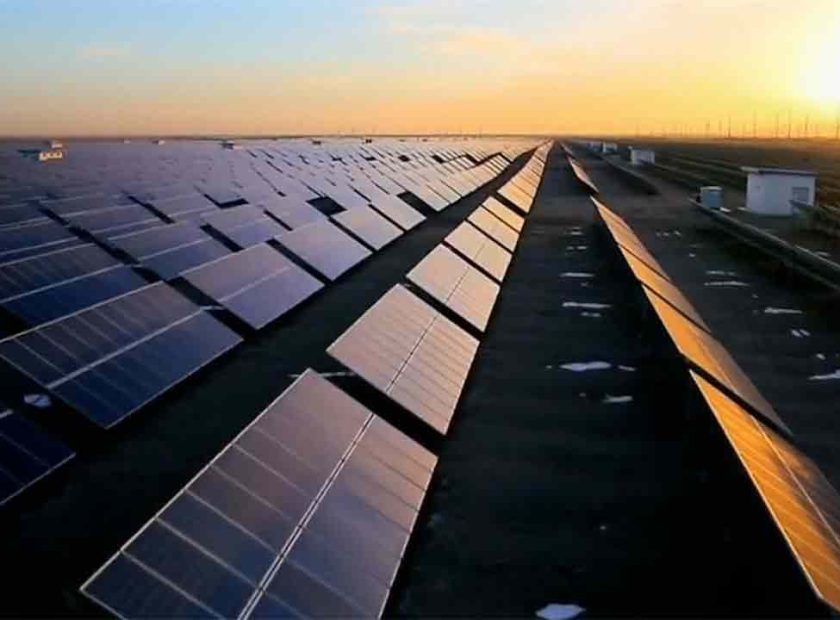
Farmland is one of the best places on earth to harvest sunlight: open space, little shading, and long, unobstructed horizons. But most farm solar arrays sit still. Panels locked at a single tilt angle miss the sun for much of the morning and late afternoon — exactly the hours when on-farm energy demand and grid prices often peak.
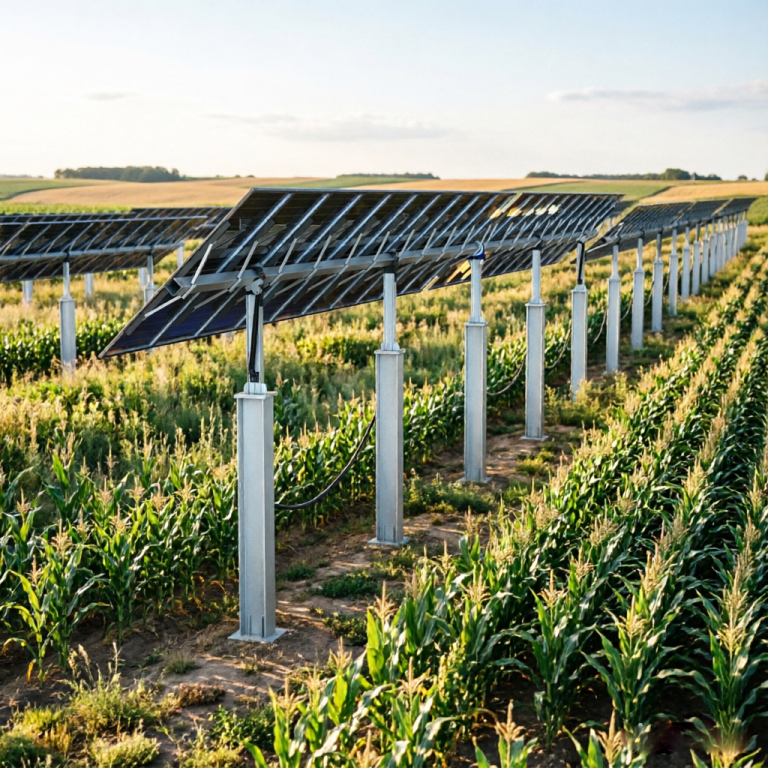
A solar tracker on farm land solves that problem. Trackers rotate panels to follow the sun across the sky, turning a static array into a system that works from dawn to dusk. Research consistently shows that single-axis trackers produce roughly 12% to 35% more energy per year than fixed-tilt systems, while dual-axis designs can add up to about 40% in favorable locations (see Sources below).
This guide explains how solar trackers work, what the yield data actually says, how trackers fit into agrivoltaics — the practice of farming and generating solar power on the same land — and what funding is available in 2026.
What Is a Solar Tracker?
A solar tracker is a mounting system that moves photovoltaic (PV) panels to keep them pointed at the sun throughout the day, maximizing the light that hits each module.
There are three main configurations used on farmland:
| Type | How it moves | Typical yield gain vs. fixed-tilt | Best for |
| Single-axis tracker | Rotates east-to-west on one horizontal axis | ~12–35% annually | Large, open farm fields; utility and commercial farm solar |
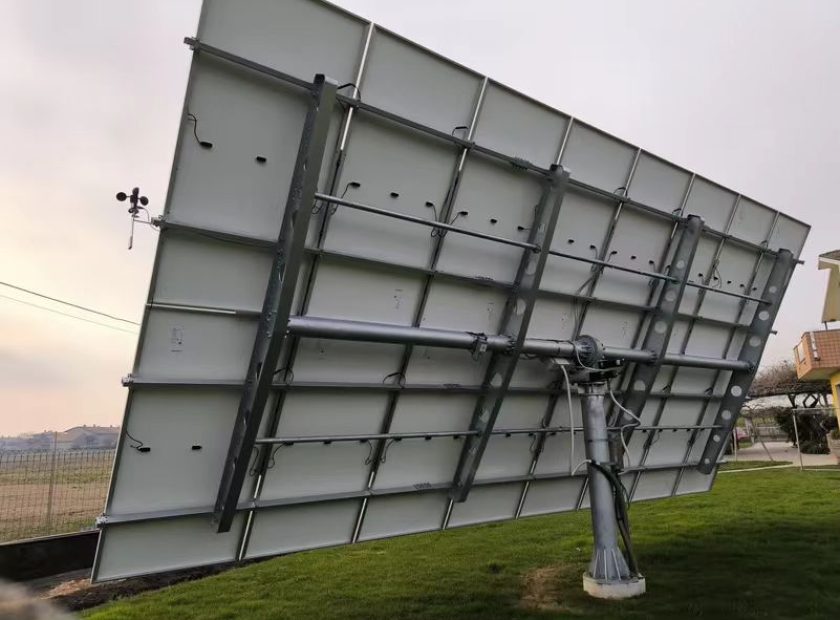
| Dual-axis tracker | Tilts and rotates on two axes | Up to ~40% | Smaller systems, high-latitude sites, research installations |
| Fixed-tilt racking | Does not move | Baseline | Steep terrain, tight budgets, minimal maintenance tolerance |
The single-axis tracker dominates modern farm and utility-scale projects. It captures most of the available tracking gain with far less mechanical complexity than a dual-axis system, which keeps both cost and maintenance manageable.
How Much Extra Energy Does a Solar Tracker on Farm Land Actually Produce?
Yield gains vary by latitude, climate, and system design, but the published research clusters in a consistent range:
- A 2025 peer-reviewed review of tracking systems found single-axis trackers achieving 20–35% higher energy yield than fixed-tilt baselines, with dual-axis trackers offering further gains.
- Industry analysis citing International Energy Agency (IEA) research puts single-axis tracker gains at 12–25% more electricity annually compared with fixed installations.
- Comparative studies of dual-axis systems report energy collection increases of up to about 40%.
Why the gain matters more on a farm than on a rooftop
Two farm-specific factors amplify the value of tracking:
- Flatter production curves match farm loads. Irrigation pumps, grain dryers, and cooling systems often run in early morning or late afternoon. Trackers keep panels producing during those shoulder hours, when a fixed array is already (or still) nearly flat.
- Better economics per acre. Farm solar is land-constrained. If a tracker yields 20% more energy on the same acreage, the revenue per acre rises proportionally — a meaningful number when a lease or loan payment is tied to the parcel.
Trackers vs. Fixed-Tilt on Farmland: The Trade-Offs
A solar tracker on farm ground is not automatically the right call. Weigh the trade-offs honestly:
Advantages of trackers
- 12–35%+ more annual energy from the same array size
- Production shifted into morning and evening hours, often when electricity prices are higher
- Higher revenue per acre for leased or owned farmland
Costs and considerations
- Higher upfront cost per kilowatt than fixed racking (the extra hardware, motors, and controllers)
- Moving parts require inspection and occasional maintenance; a well-run tracker program budgets for this
- Wind engineering matters: trackers “stow” flat or tilted in high winds, and site wind data should drive the design
- Slightly more land area can be needed for access and maintenance around moving rows
For most ground-mounted farm systems on reasonably flat land, the extra yield outweighs the added cost over the system’s 25+ year life — which is why single-axis trackers have become the default for new utility-scale solar. On small, irregular, or heavily shaded parcels, fixed-tilt can still win on simplicity.
Agrivoltaics: Farming and Solar on the Same Land
The strongest argument for solar on farmland isn’t energy alone — it’s dual use. Agrivoltaics combines crop or livestock production with solar generation on the same parcel, and it is growing quickly.
Key data points:
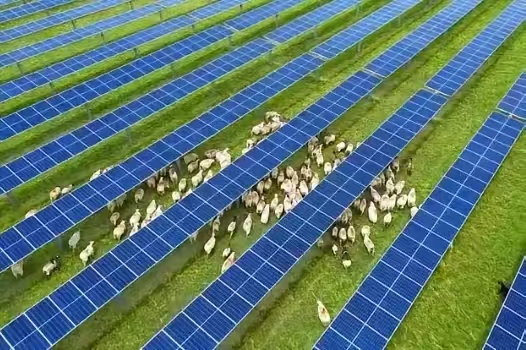
- The first U.S. solar grazing census, conducted by the National Renewable Energy Laboratory (NREL) and the American Solar Grazing Association, counted more than 113,000 sheep grazing across roughly 129,000 acres of solar installations.
- USDA Economic Research Service reporting on agrivoltaics sites found that just over a quarter combine solar panels with sheep grazing, while fewer than 5% include crops grown beneath the panels — suggesting large untapped crop potential.
- Research summarized by development-economics researchers indicates agrivoltaic shading can cut crop water demand by around 20%, a significant benefit in drought-prone regions.
- One industry analysis suggests agrivoltaics can increase the economic value of farm land by more than 30% compared with conventional farming alone.
Sheep, trackers, and one practical caveat
Sheep are the ideal “mowers” under solar arrays: they’re light, don’t damage racking, and eliminate mechanical mowing costs. If you plan to graze under a solar tracker on farm ground, design for it:
- Specify livestock-safe cable management (conduit, buried runs, and no accessible wiring below grazing height). Sheep will chew anything reachable.
- Keep trackers in a grazing-safe stow position; most developers stow panels at a height and angle that keeps livestock clear of moving edges.
- Coordinate stocking rates with the developer’s vegetation plan so ground cover survives the season.
Done right, grazing under trackers creates two income streams on one acre: energy revenue and livestock revenue.
Money and Incentives for Farm Solar in 2026
Funding is where the math changes fastest, so verify current terms with a tax professional and the USDA before committing. As of this writing:
Federal Investment Tax Credit (ITC). Solar projects have historically qualified for a federal tax credit of up to 30% of system cost. Under the tax legislation signed in July 2025 (the One Big Beautiful Bill Act), eligibility now hinges on deadlines: solar projects must begin construction before July 5, 2026, or be placed in service before January 1, 2028 to qualify for the credit. If you are considering a farm solar project, the clock is a real factor in your decision.
USDA Rural Energy for America Program (REAP). REAP provides grant funding and guaranteed loan financing to agricultural producers and rural small businesses for renewable energy systems, including solar. Program terms, application windows, and funding levels change from year to year — USDA has even shifted application schedules recently — so check the current round with your USDA Rural Development state office before planning around a specific award.
Land lease revenue. If you prefer not to own the system, solar developers commonly lease farmland for arrays, paying annual per-acre rent that often exceeds returns from marginal cropland. Trackers increase the energy yield of the leased site, which strengthens the economics for both sides.
Before You Install a Solar Tracker on Farm Land: A Checklist
- Site the right acres. Flat or gently rolling ground, minimal shading, firm soil for pile driving, and room for maintenance access.
- Check setbacks and zoning. County ordinances often govern setbacks from property lines, residences, and roads.
- Get the grid answer early. Interconnection capacity and cost can make or break a project; request a feasibility review from your utility first.
- Plan for water and drainage. Racking and access roads change how water moves across a field; include drainage engineering in the design.
- Decide the land use beneath the array. Sheep grazing, pollinator habitat, or crops each imply different panel heights, row spacing, and equipment choices.
- Budget for operations. Ask tracker vendors for maintenance schedules, spare-part lead times, and warranty terms on motors and controllers.
- Lock in incentives early. With the 2026/2028 federal deadlines in play, talk to your tax advisor before the calendar decides for you.
Frequently Asked Questions
How much more energy does a solar tracker on a farm produce?
Most studies put single-axis tracker gains at roughly 12–35% more annual energy than fixed-tilt panels, depending on latitude and climate. Dual-axis trackers can add up to about 40%, at higher cost and maintenance.
Are solar trackers worth it compared with fixed panels on farmland?
On open, reasonably flat farmland, usually yes — the extra yield per acre typically outweighs the added hardware cost over a 25-year system life. For small or shaded parcels, fixed-tilt can be the simpler, cheaper choice.
Can livestock graze under solar trackers?
Yes — sheep grazing under solar is a fast-growing practice, with more than 113,000 sheep counted across roughly 129,000 acres of U.S. solar sites in the first national census. With trackers, require livestock-safe cable management and grazing-safe stow positions in the design.
Do solar trackers need a lot of maintenance?
More than fixed racking, since motors, bearings, and controllers have moving parts. Modern trackers are designed for low-touch operation, but budget for periodic inspection and keep spare parts available.
What funding is available for farm solar?
In the U.S., the main programs are the federal Investment Tax Credit (subject to construction/placed-in-service deadlines set by the 2025 tax law) and USDA REAP grants and loan guarantees for agricultural producers. State programs vary — check with your state energy office.
The Bottom Line
A solar tracker on farm land converts the farm’s biggest natural advantage — wide-open sunlight — into 12% to 35% more energy from the same panels and the same acres. Paired with agrivoltaics, the same parcel can keep producing food, forage, or grazing while it produces power. The economics favor acting with eyes open: site carefully, design for the land use underneath, and talk to your tax advisor while federal incentives are still on the table.
Sources
- Sadeghi, R. et al., “A Review and Comparative Analysis of Solar Tracking Systems,” Energies 18(10):2553 (2025) — single-axis trackers 20–35% higher yield; dual-axis gains beyond that.
- IEA-based research as cited in industry comparisons (e.g., Anern, 2025) — single-axis trackers generate 12–25% more electricity annually than fixed systems.
- Eiva, U.R.J. et al., “Comprehensive analysis of fixed tilt and dual-axis tracking photovoltaic systems,” Renewable Energy (2025) — dual-axis tracking can increase collected energy by up to 40%.
- pv magazine USA (2025), “Solar grazing undergoing rapid growth, census finds” — NREL/American Solar Grazing Association census: 113,000+ sheep on 129,000 acres.
- USDA Economic Research Service, Amber Waves (April 2024), “Common Ground for Agriculture and Solar Energy” — ~25% of agrivoltaics sites combine panels with sheep grazing; <5% include crops.
- International Growth Centre (2024), “Environmental and economic impacts of agrivoltaics” — agrivoltaics can reduce crop water needs by ~20%.
- SSII (2025), “Agrivoltaics: Solar on Farms is a Promising Option” — agrivoltaics may increase farm land economic value by >30%.
- USDA Rural Development — Rural Energy for America Program (REAP) program pages; Biodiesel Magazine (2026) on FY2026 REAP application schedule changes.
White & Case (2025) and Novoco analyses of the One Big Beautiful Bill Act (H.R.1, signed July 4, 2025) — solar ITC/PTC deadlines: construction beginning before July 5, 2026, or placed in service before January 1, 2028.