


Solar Power on Balcony: Market Outlook & Growth 2026
Solar power on balcony systems moved from a German hobbyist curiosity to a mainstream consumer appliance in under four years. Today more than 1.3 million plug-in units are registered in Germany alone, the United Kingdom legalised self-installation on 27 August 2026, and over twenty US states have tabled bills to follow.
What Exactly Is Solar Power on Balcony?
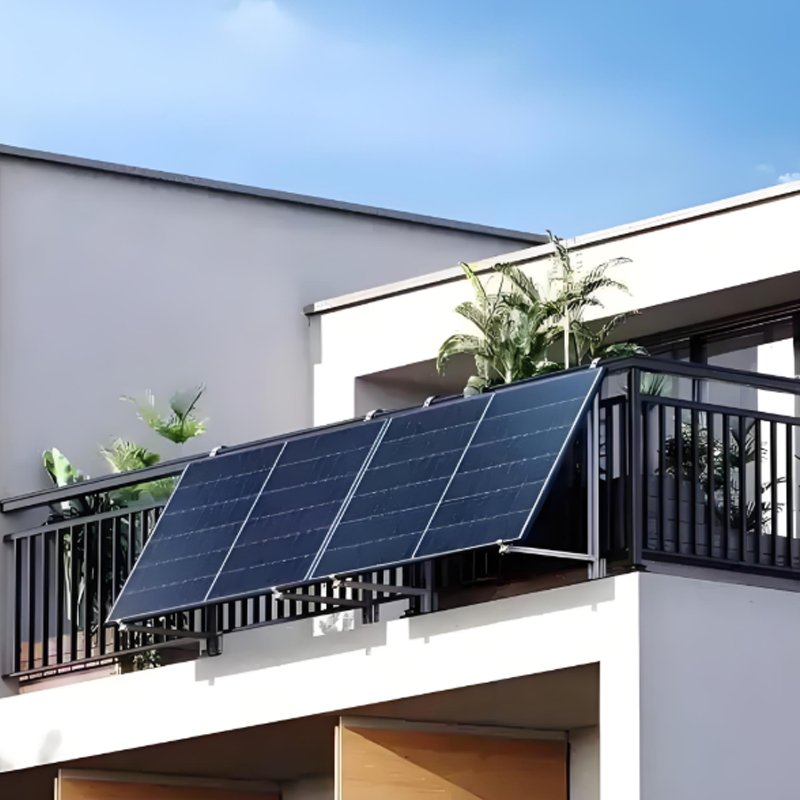
Solar power on a balcony — also called plug-in solar, balcony solar, plug-in PV, or, in German, Balkonkraftwerk (“balcony power plant”) — is a grid-connected micro solar system small enough that a renter can install it without an electrician.
A typical kit contains three parts:
- One or two PV modules (400–1,000 Wp each), zip-tied or clamped to a balcony railing, wall, or flat-roof mount.
- A microinverter (roughly the size of a shoebox) that converts DC to household AC and, critically, limits grid injection.
- A standard plug that feeds the home’s existing socket circuit.
The electricity flows into the home and offsets whatever appliances are running at that moment. Anything left over goes to the grid — and, in most markets, earns nothing. This “self-consumption only” design is what makes the systems cheap, portable, and legally simple: no roof penetrations, no dedicated meter cabinet, no utility interconnection queue.
That distinction matters. Rooftop solar is a construction project. Balcony solar is a purchase.
Where the Market Stands in 2026
The numbers are the strongest argument that this segment is not a fad.
| Metric | Value |
| Germany: registered balcony systems (cumulative) | 1,031,298 → over 1.33 million |
| Germany: capacity | ~2.5 GW |
| Germany: new plug-in PV, Jan–Jul 2026 | 346.5 MW |
| Germany: new plug-in PV, July 2026 alone | 62 MW |
| Germany: Q1 2026 additions | 64,000+ systems / 87.6 MW |
| Netherlands: installed systems | 500,000+ ⚠️ single source |
| Typical German retail price (800 W, 2 modules) | €350–500 |
| UK: expected annual saving per household | up to £110 |
| Global balcony PV market size | US$1.25B (2025) → US$3.48B (2032), 15.8% CAGR |
| Global balcony PV + storage market | US$1.45B (2025) → US$5.72B (2032), 19.8% CAGR |
Two observations from that table.
First, growth is decelerating in absolute terms but not collapsing. Germany added roughly 435,000 systems in 2024 and about 430,000 in 2025 — flat year over year, after a doubling from ~500,000 in mid-2024 to over 1 million by mid-2025. The market has passed its steepest adoption curve and entered volume maturity. Monthly additions of ~60 MW now represent roughly 3% of Germany’s total monthly PV build, alongside 918 MW of ground-mount and 629 MW of rooftop in July 2026.
Second, market-size forecasts diverge widely. Estimates for the global segment in 2025 range from about US$0.7B to US$5.9B depending on how the analyst defines scope (PV only vs. PV + storage, hardware only vs. installed value). Treat any single number with caution; the direction — mid-teens to high-teens percentage CAGR — is more reliable than the level.
Policy Did the Heavy Lifting — And It Is Still Moving
Balcony solar is the clearest available case study of regulation creating a market. Three policy waves define it.
Wave 1: Germany’s Solar Package I (2024)
Germany’s Solarpaket I did four things at once:
- Raised the inverter grid-injection limit from 600 W to 800 W
- Raised the permitted module capacity to 2,000 Wp
- Replaced grid-operator approval with a simple notification in the Marktstammdatenregister (MaStR)
- Removed the requirement for a bidirectional smart meter and gave tenants a legal right to install
Registration dropped from 435,000 (2024) to a frictionless form-filling exercise. Adoption followed immediately. Germany also applies 0% VAT to residential PV systems under 30 kW, which materially improves the payback math.
Wave 2: Safety Standards Catch Up (December 2025 – March 2026)
For years, plug-in solar sat in a regulatory grey zone — tolerated, widely sold, but with no product-level standard. That ended with DIN VDE V 0126-95, published 14 November 2025 and effective 1 December 2025: the world’s first product-safety standard treating a plug-in PV system as a complete appliance. It formally accepts the ordinary Schuko household plug (with strict anti-touch requirements on the microinverter), caps inverter output at 800 VA, and allows 800 Wp of modules on a Schuko plug (960 Wp including 20% tolerance) or 2,000 Wp on a dedicated energy plug.
Then VDE-AR-N 4105:2026-03, effective 1 March 2026, reportedly went further: grid injection stays hard-capped at 800 VA, but the DC module capacity connected to the inverter may now reach 7,000 W ⚠️ single source — verify against the VDE document before citing commercially. If confirmed, that is a significant signal: it would allow heavy module over-sizing for weak-light and winter performance, which is precisely the use case balcony owners have.
Wave 3: The UK and the US Open Up (2026)
United Kingdom. Under Statutory Instrument 2026/848, with updates to the G98 distribution code and BS 7671 Amendment 4, households may legally self-install plug-in solar up to 800 W from 27 August 2026 — no electrician required. Amazon, Currys, Argos, Wickes and Lidl have committed to stocking kits, with 800 W systems priced around £400–600. The government estimates savings of up to £110 per year, roughly 20% of an average household’s consumption. Two constraints worth noting: battery storage is excluded from the plug-and-play scope, and surplus power earns no Smart Export Guarantee revenue — self-consumption only.
United States. Utah moved first in March 2025, allowing systems up to 1,200 W to connect without utility approval and explicitly barring landlords with four or more units from prohibiting them. Virginia approved similar legislation in March 2026. By early 2026, 28 states plus Washington DC had introduced plug-in solar bills. Products must meet UL 3700. The headwind: the federal Section 25D residential clean energy credit expired on 31 December 2025, so US adoption rests on state law and retail economics rather than federal subsidy.
Rest of Europe. Belgium legalised plug-in solar in April 2025, though Flanders’ 800 W-per-meter rule has drawn a legal challenge. Austria, the Netherlands, Italy, Greece and France are all cited by industry analysts as next-wave markets. The EU’s revised Renewable Energy Directive pushes member states to simplify permitting for sub-800 W systems.
The Economics: What Does Solar Power on Balcony Actually Return?
This is where marketing claims and reality diverge most sharply.
Cost
- Germany: €200–500 for a complete 800 W two-module kit; around €350 for the mainstream configuration.
- UK: £400–600 for comparable 800 W kits at launch.
- US: entry kits from roughly $300; $1,400–2,000 for an 800 W system with battery. A pv magazine analysis in March 2026 demonstrated a DIY build at $0.65/W using secondary-market components.
- Premium tier: full balcony solar-plus-storage systems showcased at IFA Berlin 2026 exceeded €1,500.
Yield — the honest version
Vendor materials routinely quote peak-watt figures. Real output depends heavily on orientation and mounting:
| Condition | Typical daily output | Note |
| 800 W kit, south-facing, clear day | ~3 kWh | Best realistic case |
| 800 W kit, overcast | 1–1.5 kWh | ~60–70% below clear-day output |
| 1 kW system, south-facing, clear day | 3–4 kWh | — |
| Vertical railing mount vs. optimal tilt | −20% | Most balcony installs are vertical |
| East or west facing vs. south | −20% to −30% | — |
| North facing vs. south | −40% to −60% | — |
| Behind single glazing (enclosed balcony) | −10% to −15% | — |
| Behind double-glazed / Low-E glass | −20% to −30% | A common mistake |
| Uncleaned, dusty modules | −15% to −20% | — |
A south-facing 800 W system in southern Germany generating roughly 700–800 kWh/year is a defensible planning figure; a north-facing vertical panel behind Low-E glass may deliver less than half that.
Payback
- Germany: ~2–5 years for PV-only at current retail prices (~€0.30–0.40/kWh); longer once a battery is added.
- UK: “three to five years is a realistic payback period,” per installer and analyst commentary in July 2026 — consistent with the government’s £110/year estimate against a £400–600 kit.
- US: 2–5 years if annual savings reach roughly $300 (EnergySage); longer in low-tariff states. For context, conventional US rooftop systems run 5–14 years.
The economics are genuinely good — but they are appliance-grade, not investment-grade. A balcony system will not move a household’s energy bill dramatically; it shaves 10–25% off it.
The Real Story of 2026–2030: Balcony Solar Becomes Balcony Storage
The hardware-only phase is ending. Three forces are pushing storage into the product category:
- Feed-in tariffs are disappearing.Germany’s EEG 2027 draftproposes ending fixed feed-in tariffs for small PV systems commissioned from 2027 onward. The Netherlands has approved the phase-out of net metering, targeted for 2027 (though the policy has been delayed repeatedly). When surplus export earns nothing, the only way to capture midday generation is to store it.
- Dynamic tariffs need a buffer.Time-of-use pricing rewards shifting consumption. Germany’s smart-meter penetration is only about 3%, which caps how much of that theoretical saving households can actually access today — but that infrastructure gap is itself a growth runway.
- Negative prices are now routine.Germany curtailed roughly 3 GWh of solar in H1 2026, 58.2% of it during negative day-ahead prices; about 1.28 TWh was curtailed in May 2026 alone. Midday power is increasingly worthless. Storage converts a waste product into an evening asset.
The consequence: the storage-attached segment is forecast to grow faster (~19.8% CAGR) than PV-only (~15.8%), per PW Consulting ⚠️ single source. Analysts at Chinese brokerages estimate the balcony solar-plus-storage addressable market in “opened-up” countries at roughly RMB 36.8 billion, with a broader long-term pool above RMB 230 billion for apartment scenarios ⚠️ broker estimate, single source.
Who Is Competing — And What That Signals
The vendor list changed dramatically in 2026, and the change itself is the tell.
Consumer-electronics giants have entered. At IFA Berlin in September 2026, drone maker DJI displayed PV modules, microinverters and a Power 2000 battery assembled into a complete balcony solar system — priced above €1,500. Anker Innovations launched a balcony solar-storage product in May 2026. BYD and Bull Group (公牛) have moved in. IKEA now sells balcony PV kits in Germany.
Chinese manufacturers hold the volume position. Industry reporting puts Chinese brands at roughly 80% of the European balcony storage market in 2026 ⚠️ trade-press estimate, single source.
Why does this matter for the outlook? Three reasons:
- Price compression is coming. Marstek’s €499 storage-inclusive pricing already signals thin hardware margins. Expect continued deflation.
- Distribution shifts to retail. When IKEA, Amazon, Currys and Lidl stock the product, it has left the specialist channel. That expands the buyer pool far beyond early adopters.
- Brand premium is emerging. DJI’s €1,500 system next to a €350 commodity kit shows the category bifurcating into value and premium tiers — a hallmark of a maturing consumer market.
The counter-signal: the European Union’s ban, from 1 May 2026, on public funding for projects using inverters from designated “high-risk countries,” plus Germany’s legislative review under its IT Security Act. This is a live geopolitical risk for the dominant suppliers and could reshape the vendor field faster than economics would.
Five Challenges That Could Slow the Curve
An honest outlook has to price the downside.
- The safety debate is unresolved.Over one million systems installed with no reported incidents attributable to correct use is a strong record. But peer-reviewed work (Energies, April 2025) identifies three persistent technical barriers: touch safetyat the plug, breaker masking (a PV feed can prevent a circuit breaker from tripping on a downstream fault), and the absence of unified standards. MIT Technology Review flagged electrical-code compatibility concerns in May 2026. In the US, safety arguments remain the principal obstacle in state legislatures. VDE 0126-95 addresses much of this in Europe — the US has no equivalent yet.
- Real-world yield disappoints.Vertical mounting, railing shading, north-facing aspect and glazing losses mean many owners generate far less than the nameplate implies. Churn and negative word-of-mouth are a genuine risk to a retail-driven category.
- Grid interaction at scale.At hundreds of megawatts per country, aggregate plug-in solar contributes to midday voltage rise. China’s rural experience is instructive: dense household PV in Henan pushed distribution-transformer voltages past limits (258 V in one 10 kW case), forcing inverters to curtail or trip, and requiring State Grid Luohe to rebuild 144 problem lines and install 261 smart switches in Q1 2026. Balcony systems are individually tiny, but they are unmanaged and unmetered at the edge.
- Policy reversal risk.The US federal 25D credit is already gone. Germany’s 0% VAT, Austrian subsidy frameworks and the Dutch net-metering phase-out timeline all remain politically contingent. A segment built on regulation can be unbuilt by it.
- Price war erodes quality.Analysts warning about the European market note that razor-thin hardware margins may compress R&D and service investment just as installed base grows into the millions — the point at which after-sales burden peaks.
Outlook 2027–2030: Three Scenarios
Base case — steady geographic expansion. Germany plateaus near 1.5–2 million systems. The UK, Netherlands, Austria, Italy and Belgium replicate a slower version of the German curve. The US legalises plug-in solar in 15–25 states but adoption lags Europe by 3–5 years because of lower retail tariffs and no federal incentive. Storage attach rate climbs from single digits toward 30–40%. Global segment CAGR settles at 12–18%. This is the most likely path given current legislation.
Upside case — storage plus retail distribution unlock a second wave. Smart-meter rollout accelerates, dynamic tariffs spread, EEG 2027 removes feed-in tariffs and makes storage economically mandatory, and mass retailers normalise the purchase. Segment growth re-accelerates to 20%+ and balcony systems become a standard household appliance in Northern Europe. Wood Mackenzie’s broader forecast — global solar capacity nearly tripling from ~3 TWdc today to ~8 TWdc by 2034 — is consistent with this.
Downside case — regulatory and geopolitical contraction. A high-profile electrical incident, an aggressive utility lobby, or enforcement of the EU inverter funding ban combined with national security reviews sharply raises compliance cost. Growth stalls in Europe, US state bills die in committee, and the segment remains a German and Dutch niche.
The macro context worth remembering
SolarPower Europe’s Global Market Outlook 2025–2029 expects a short-lived stagnation in global PV growth in 2026 as China adjusts to its new market design, after nearly 600 GW installed in 2024 (+33% year on year). Balcony solar is counter-cyclical to that: it is driven by retail tariffs and housing structure, not by utility procurement. DIW energy economist Claudia Kemfert estimates plug-in solar could cover up to 2% of German electricity demand by 2045 — modest in system terms, but large as a distributed, citizen-owned asset.
Bottom line. Solar power on balcony will not solve the energy transition. It will, however, become a normal consumer product across Europe within this decade, with the US following on a state-by-state basis. The investment case is shifting from “sell panels” to “sell stored self-consumption” — and the winners will be those who solve safety certification, retail distribution and battery economics together.
Frequently Asked Questions
Is solar power on balcony legal?
In Germany, Austria, the Netherlands, Belgium and — since 27 August 2026 — the United Kingdom, yes, up to 800 W of inverter output with self-installation permitted. In the US, legality varies by state: Utah and Virginia have passed laws, and 28 states plus DC have introduced bills. Always check local rules and, if renting, your tenancy agreement.
How much electricity does an 800 W balcony system produce?
A south-facing 800 W kit produces roughly 3 kWh on a clear day and 1–1.5 kWh when overcast — about 700–800 kWh per year in central Europe. Vertical mounting costs around 20% versus optimal tilt; north-facing loses 40–60%.
How long does balcony solar take to pay for itself?
Two to five years in Germany and the UK at current retail electricity prices; two to five years in the US if annual savings reach about $300. Adding a battery extends the payback period.
Can renters install solar power on a balcony?
Generally yes, and this is the segment’s core advantage. Germany’s Solar Package I gave tenants an installation right. Utah’s law prevents landlords with four or more units from banning plug-in solar. Systems are portable, so they move with you.
Does surplus power get paid?
Usually no. Most plug-in solar regimes are self-consumption only. The UK explicitly excludes these systems from Smart Export Guarantee payments, and Germany’s EEG 2027 draft proposes removing feed-in tariffs for new small systems from 2027 — the main reason battery attachment is rising.
Is balcony solar safe?
Germany has recorded no incidents attributable to correct use across more than one million registered systems, and DIN VDE V 0126-95 (effective December 2025) sets the first product-level safety standard. Open technical concerns include plug touch safety and breaker masking. Buy only certified kits and never modify the inverter or wiring.
Do I need a battery?
Not yet, but increasingly it makes financial sense. With feed-in tariffs being withdrawn and midday prices frequently negative, a battery is the only way to use afternoon generation in the evening. Expect storage-attached systems to grow faster than PV-only through 2030.