
Solar Carports: How Steel Structures Turn Parking Spaces Into Power Plants
Every day, millions of parking spaces sit under the sun — vast, paved, and largely wasted. A solar carport turns that idle asphalt into a productive asset: a shaded canopy that generates clean electricity while protecting the vehicles parked beneath it.
As land costs rise and sustainability mandates tighten, solar carports have become one of the fastest-growing applications in distributed solar energy. From supermarket parking lots to railway stations, steel-framed solar carports now deliver three core benefits in a single structure: reliable shading, meaningful power generation, and engineered wind resistance. This guide explains how they work and why steel is the structure of choice.
What Is a Solar Carport?
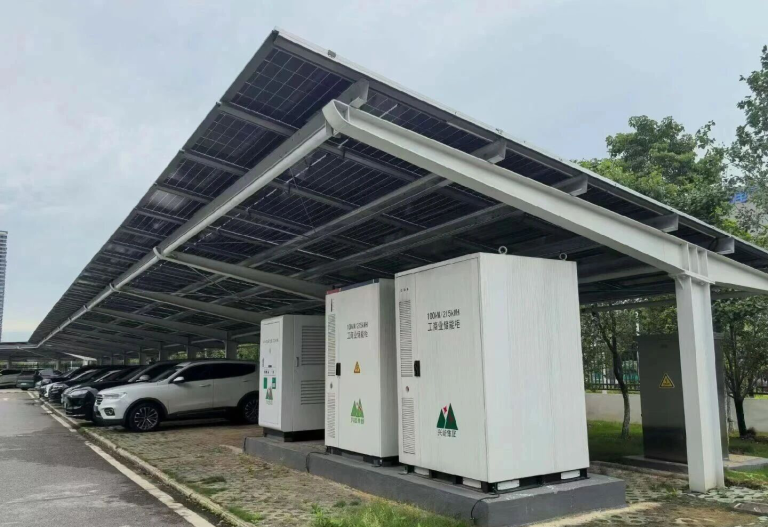
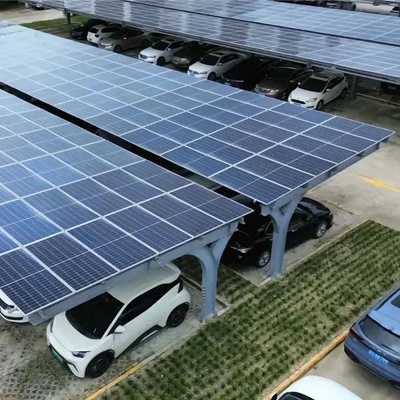
A solar carport — also called a solar canopy, PV carport, or solar parking shelter — is a roofed structure built over parking spaces with photovoltaic (PV) modules mounted on its roof. Unlike a ground-mounted solar farm that consumes extra land, a solar carport performs two jobs on the same footprint: parking below, power above.
Most modern solar carports are built on a steel primary structure — hot-dip galvanized columns, beams, purlins, and bracing — that supports the PV modules, inverters, cable routing, and often EV chargers. Policy is accelerating adoption as well: South Korea now requires parking lots with 80 or more spaces to install solar canopies, with existing lots given a transition period to retrofit, according to reports on the country’s amended renewable energy decree.
Why Steel Is the Backbone of a Modern Solar Carport
Aluminum and timber are used in some designs, but steel dominates commercial solar carport construction for good reason:
- Strength and long clear spans. Steel columns and beams easily span six meters or more between supports, giving drivers wide, unobstructed parking bays and maneuvering space.
- Durability. Hot-dip galvanized steel resists corrosion for decades, even in coastal or industrial environments, with minimal maintenance.
- Prefabrication and speed. Steel carports are fabricated off-site and bolted together quickly, shortening installation time and reducing disruption to busy parking lots.
- Design flexibility. Single-slope, double-slope, multi-row, and cantilevered layouts can all be engineered in steel, with custom column heights for trucks, RVs, or buses.
- Fire resistance and recyclability. Steel is non-combustible and fully recyclable at end of life, supporting ESG and green-building goals.
Benefit 1: Shading and Weather Protection
A steel solar carport is, first and foremost, a high-performance shelter. The PV roof blocks direct sunlight from reaching the cars below, with immediate, noticeable benefits:
- Cooler cabins. Vehicles parked in the shade heat up far less than those in open sun, so drivers spend less time — and less energy — cooling the car before driving off.
- Interior and paint protection. Dashboards, upholstery, and paint degrade under sustained UV exposure; a canopy significantly slows that wear.
- All-weather cover. Rain, frost, and hail (within design limits) are kept off vehicles, reducing damage claims for lot operators.
- Better user experience. Shaded, well-lit parking is a genuine amenity. Retailers, offices, and hospitals use covered parking to attract customers, tenants, and staff.
In other words, the shading function alone justifies a carport in many climates — the solar panels simply make the structure pay for itself.
Benefit 2: Clean Electricity Generation
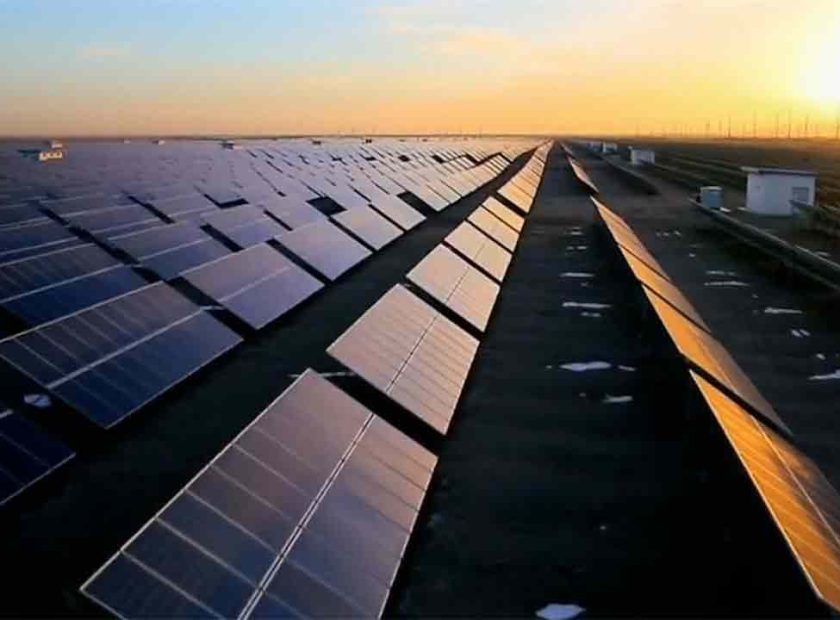
A parking lot is an unusually good site for solar: it is already open, unshaded, and close to where electricity is consumed. A typical solar carport canopy over a single parking space generates roughly 1,500 to 3,000 kWh per year, depending on location, roof tilt, and module efficiency, according to industry estimates. Scaled up, the potential is substantial: commercial solar carport lots can reach megawatt-level installed capacity and deliver hundreds of megawatt-hours of clean electricity per year.
Two design details boost yield further. First, carport canopies are elevated and open on all sides, so air circulates freely and keeps modules cooler — and cooler modules generate more power. Second, bifacial PV modules, which capture sunlight reflected off the bright pavement below, are a natural fit for carports and are increasingly specified in new projects.
The electricity can be consumed on-site to offset building loads, stored in batteries, sold back to the grid, or fed directly into EV chargers — often all of the above, managed by a smart energy controller.
Benefit 3: Engineered Wind Resistance
Wind is the governing structural challenge for any solar carport. The roof is large, elevated, and exposed, with an open underside that lets gusts generate uplift, torsion, and local pressure spikes at the roof edges and corners. A serious steel carport design addresses all of them:
- Design wind speed. Most properly designed and installed solar carports withstand wind speeds of roughly 90–150 mph, according to industry guidance. Engineered steel systems go further: one U.S. manufacturer rates its steel carport to ASCE 7-16 design wind speeds of 140–180+ mph, depending on configuration (Kern Steel). In typhoon-prone regions, South Korea’s 2025 regulation requires solar canopies to resist at least 60 m/s (216 km/h).
- Foundations and base plates. Uplift resistance starts underground. Column base plates, anchor bolts, and concrete foundations are sized for the governing wind load case, not just gravity loads.
- Bracing and connection design. Diagonal bracing, moment frames, and engineered connections transfer wind forces safely down to the foundations, controlling torsion on the long, slender canopy frames.
- Wind-tunnel validation. For large or geometrically unusual carports — such as mono-slope canopies — wind tunnel testing is used to verify pressure coefficients against code values, as demonstrated in published research on solar carport aerodynamics.
- Storm drainage. Heavy rain and storms come with wind, so integrated gutters, downspouts, and drainage paths are part of the same engineering package.
Snow Load and Other Structural Considerations
In cold climates, snow accumulation is the second governing load. Design snow loads vary widely by region: common commercial specifications range from 20 psf to 60+ psf, while South Korea’s mandate sets a floor of 1.4 kN/m² (about 29 psf) for solar canopies. Sloped canopy roofs help shed snow naturally, and structural calculations follow the applicable building code — ASCE 7 and the IBC in the United States, Eurocode in Europe, or local equivalents — with wind, snow, and seismic load combinations checked together.
Solar Carports and EV Charging: A Natural Pairing
The solar carport’s role is expanding from “shade plus power” to a full energy hub. Cars are parked for hours exactly when the sun shines, which makes the carport the ideal place to install EV chargers powered by on-site solar. Adding battery storage lets operators shift solar energy into peak-price hours and reduce demand charges. Large projects already combine solar canopies, 150 kW-class inverters, smart monitoring, and charging services in one integrated “solar-storage-charging-parking” facility — a model that turns a cost center (parking) into a revenue asset.
How Much Does a Solar Carport Cost?
Pricing varies significantly with project size, structural design, local codes, and the source you consult. Published 2025–2026 pricing guides for commercial systems span a wide range: one installation guide cites $2.75–$3.50 per watt for larger commercial projects (Solar Permit Solutions), while a market research report puts 2025 installed costs at $1.60–$2.00 per watt, down from about $2.80/W in 2020 (MarketIntelo). The gap reflects differences in scope, geography, and what each figure includes, so treat any number as a starting point, not a quote.
Payback depends mainly on local electricity rates, available incentives and tax credits, EV-charging revenue, and how much of the generation is consumed on-site. With PV modules typically carrying 25-year performance warranties and galvanized steel structures designed for a comparable service life, a solar carport is a long-lived asset that keeps producing value for decades.
Common Applications
- Retail and supermarkets — covered parking that customers notice, plus daytime load offset.
- Office and corporate campuses — visible sustainability credentials and employee EV charging.
- Industrial and logistics parks — large flat lots with high daytime energy demand.
- Schools, universities, and hospitals — shaded parking plus resilience and education value.
- Transit hubs and railway stations — megawatt-scale canopies over existing park-and-ride lots.
- Residential communities — shared solar canopies covering assigned parking spaces.
Frequently Asked Questions
How much electricity does a solar carport generate?
A typical canopy over one parking space produces roughly 1,500–3,000 kWh per year, depending on location, tilt, and module efficiency. Scaled across a commercial lot, solar carports can reach megawatt-level capacity and hundreds of megawatt-hours of annual generation.
How much wind can a steel solar carport withstand?
Most properly engineered carports handle 90–150 mph winds; steel systems designed to ASCE 7-16 are rated for 140–180+ mph, and South Korean rules for typhoon zones require resistance of at least 60 m/s (216 km/h). The key is proper foundation, bracing, and connection design.
Do solar carports keep cars cooler?
Yes — dramatically. Shaded cabins heat up far less than cars in direct sun, cutting pre-drive air-conditioning and protecting interiors and paint from UV damage.
How long does a steel solar carport last?
Hot-dip galvanized steel structures are commonly designed for 25+ years of service, aligned with the typical 25-year performance warranty of PV modules.
Is a solar carport more expensive than rooftop solar?
Cost per watt is usually higher because of the steel structure and foundations. But the carport adds covered parking, avoids roof work and reinforcement, and can directly power EV chargers — benefits a rooftop system cannot deliver.
The Bottom Line
A solar carport is more than panels on poles. Built on an engineered steel structure, it is a durable shelter that shades and protects vehicles, a distributed power plant that generates clean electricity exactly where it is consumed, and a resilient asset designed to withstand severe wind and snow. As EV adoption grows and parking-lot solar mandates spread, the steel solar carport is fast becoming the default way to make parking lots work twice as hard.